Author Archives: David

Project 1, Exercise 4 – Using Charcoal

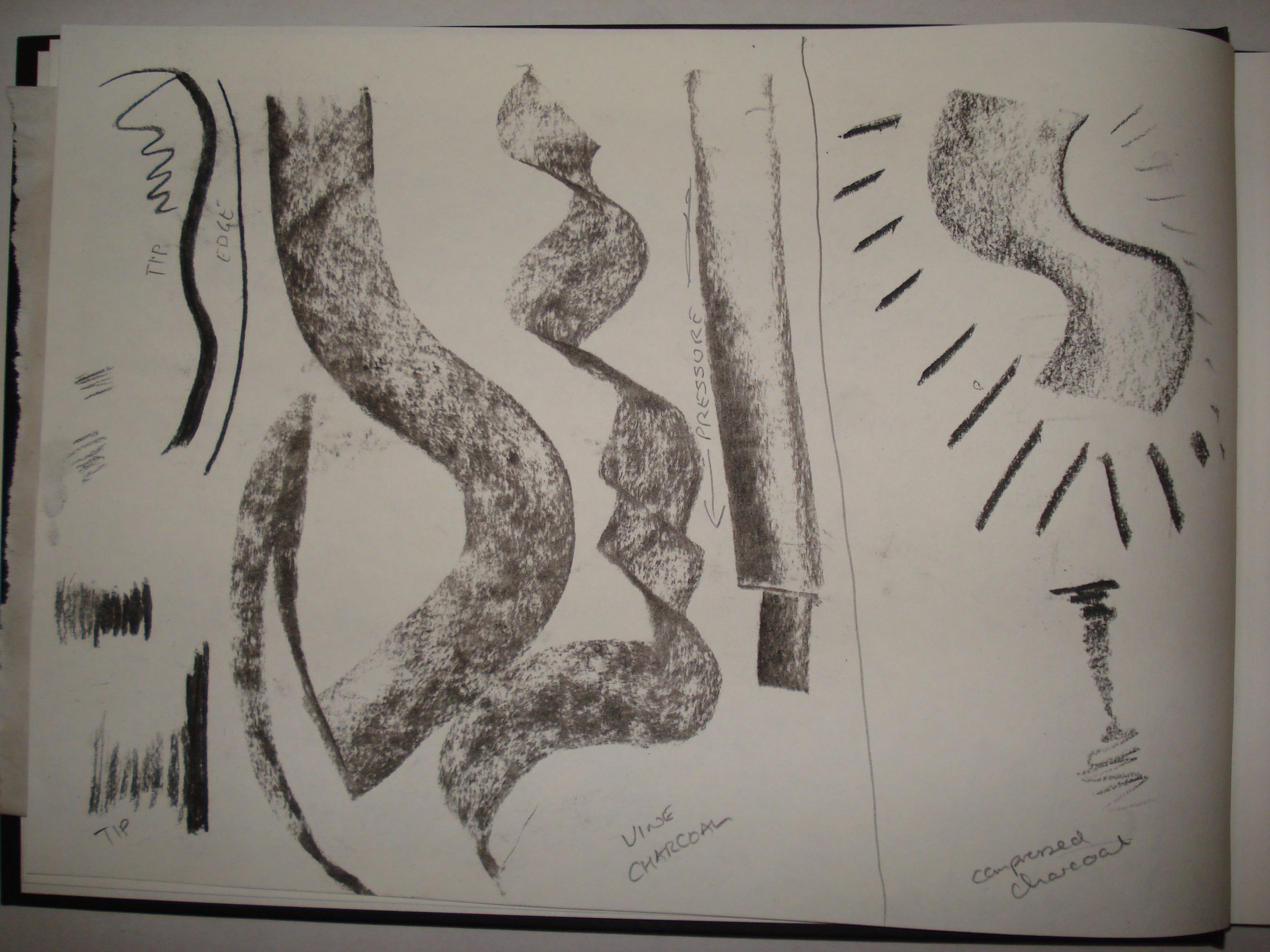
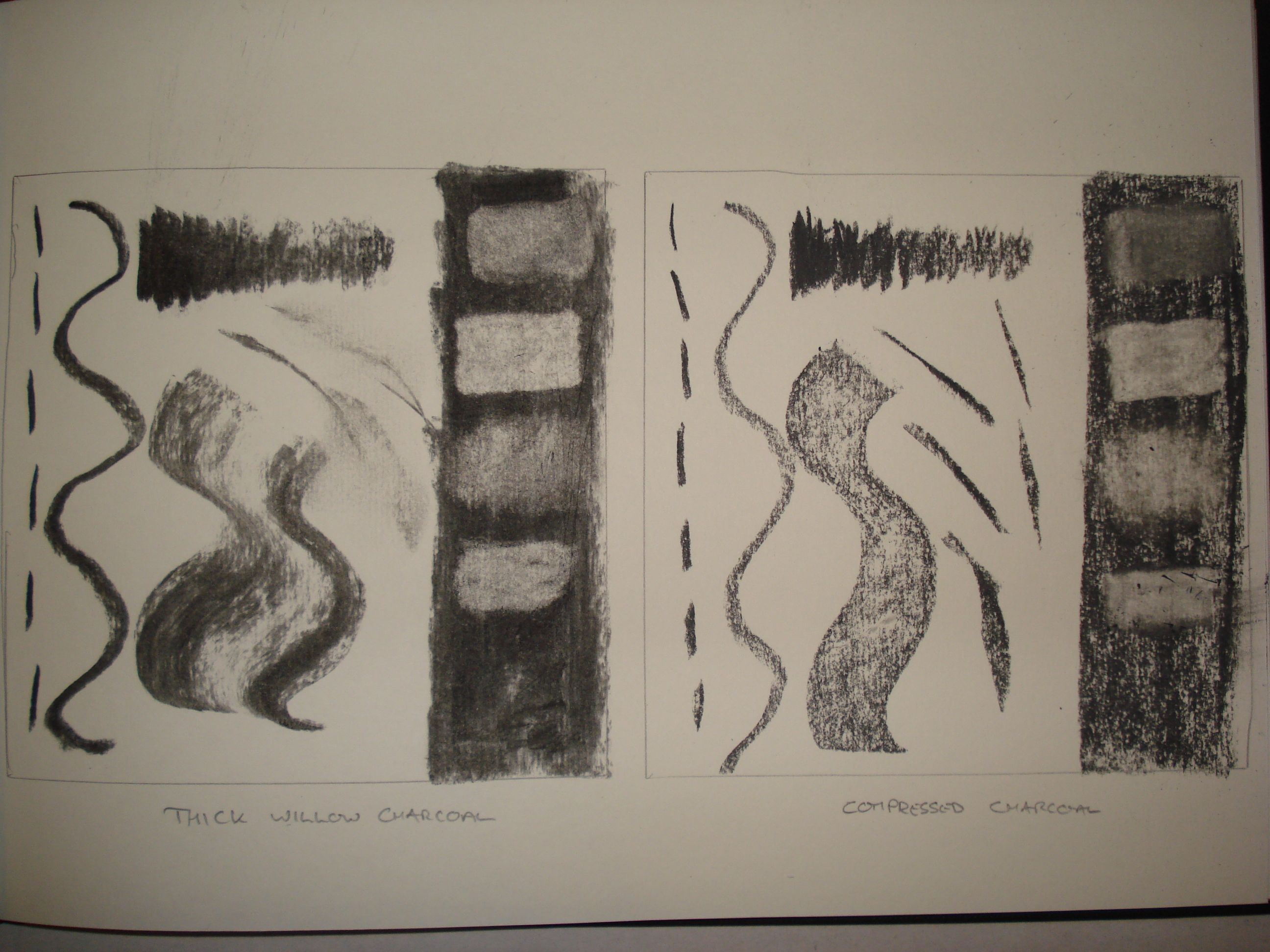
I love charcoal, but not the mess it makes.  You’ve got to prepare to make sure absolutely EVERYTHING isn’t completely covered in dust.  But it’s such an expressive medium.  I love the strong lines you can get, a love blurring the lines out – and yeah I do use it to cover up dodgy marks!  The marks that are possible with a stick on its side can be so… gestural, for want of a better word.

P1E4a P1E4b

But I’m still not getting the levels of shading I think are possible – I’ve seen work where the charcoal goes from the purest white to the deepest black.  I want to get to that point, so will have to practice.

I’m not sure how useful this exercise was – I’ve used a lot of charcoal lines in the mark making studies so far, so I’m not sure what this was supposed to add.  Maybe I’ve missed the point – distinctly possible.

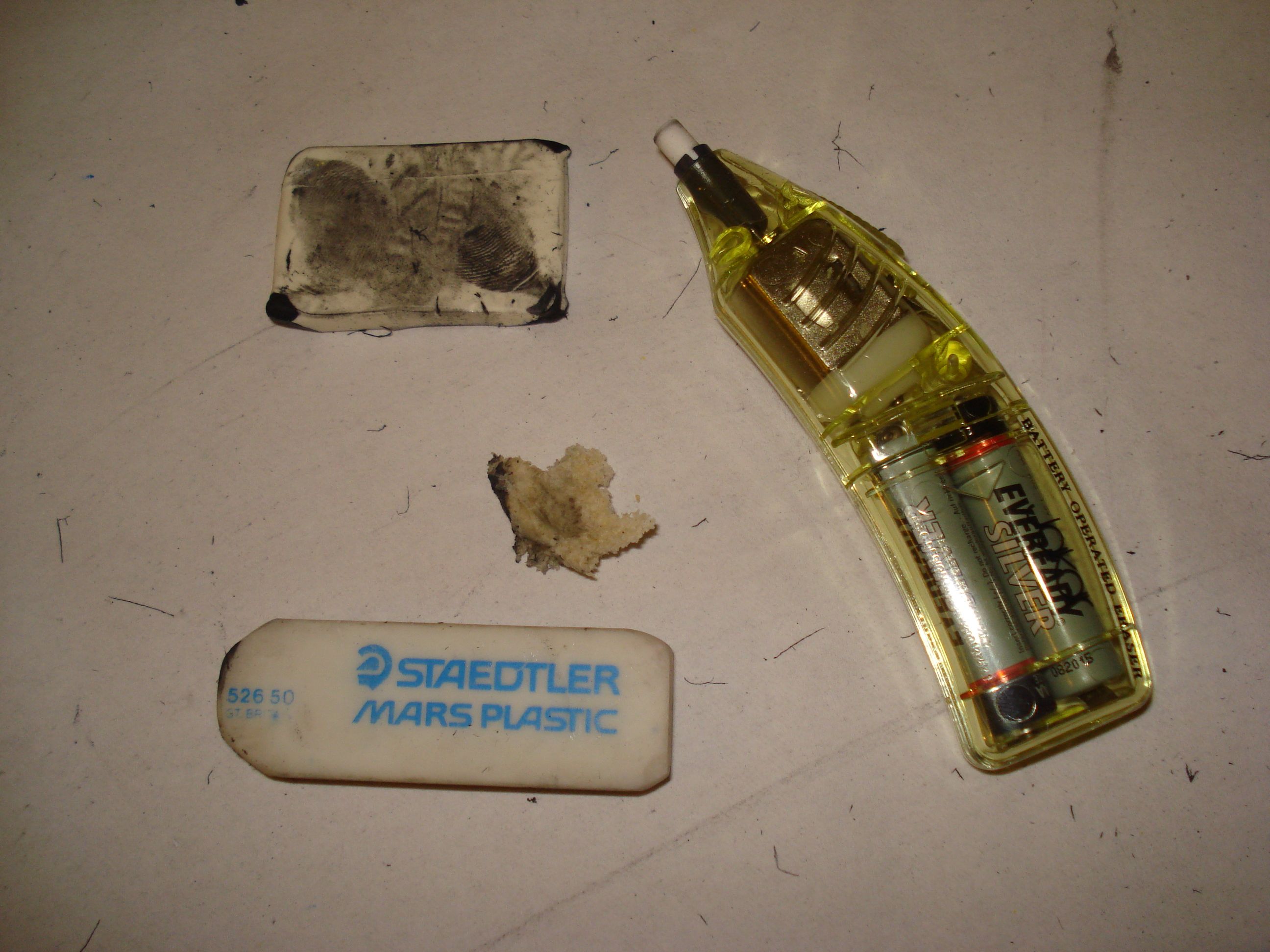
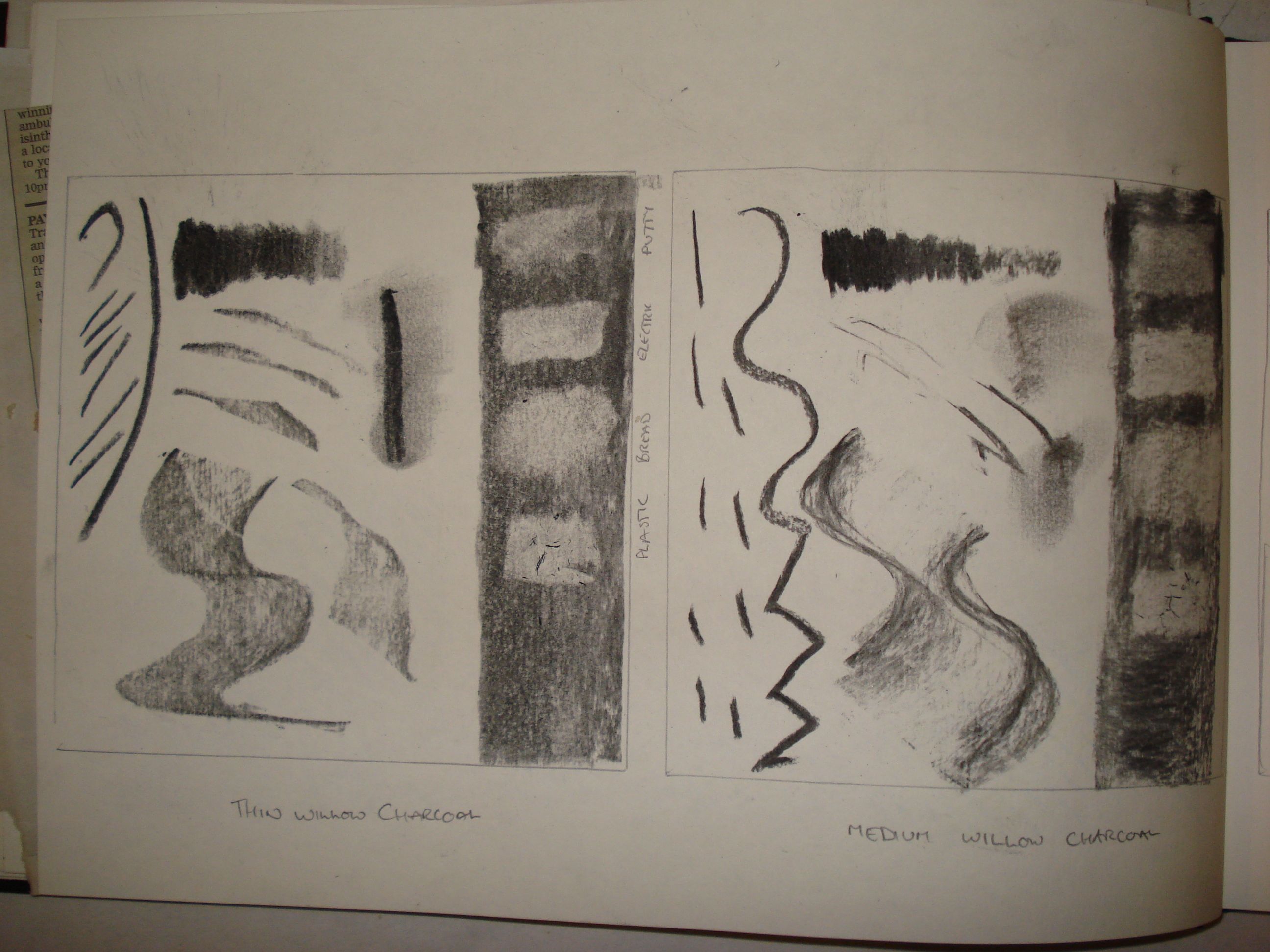
Ooh – but rubbers (erasers for any US readers!)!  I do like the fact that with charcoal you can create big swathes of black, shaded tone, and then draw into it with a rubber, creating a “negative” image, or work with negative space by rubbing out the bit’s that aren’t there.  The shaded band on each of my test squares (stencilled again!) have four rectangles rubbed out on them, one is putty rubber, one a new toy – an electric eraser, one a piece of bread and then my more usual implement, a plastic eraser.

P1E4cI’m not a fan of putty erasers, they never seem to get back to the white of the paper.  I guess they could be useful for taking a dark shading back to a lighter shade, still darker than the paper surface, but I’m not yet used to thinking in terms of “subtracting out” as a general technique rather than as a specific exercise.

Project 2, Exercise 3 – Mark Making Techniques

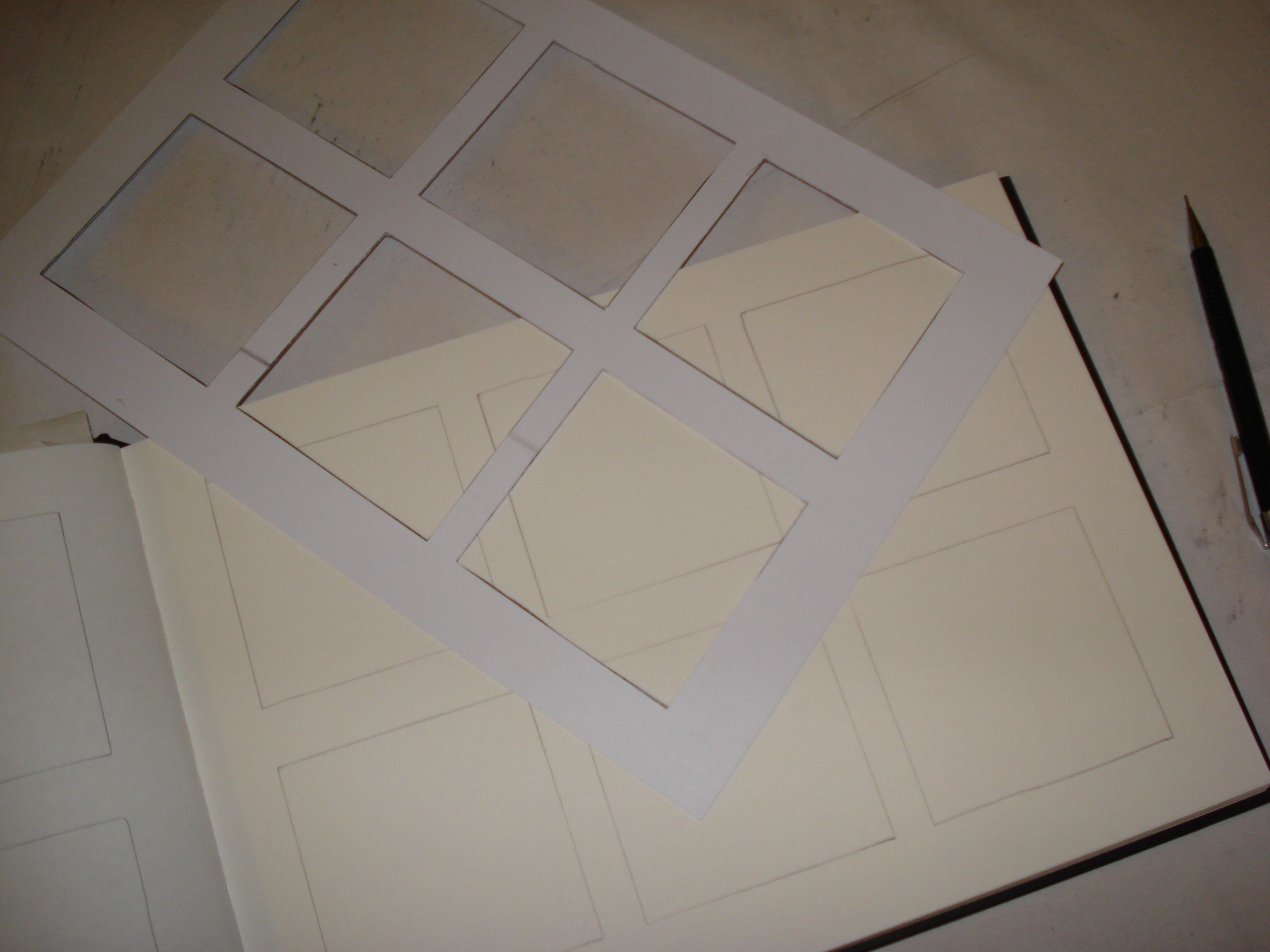
You know what part of this (and forthcoming excercise) got me worked up?  The squares.  I was getting freaked out that my squares wouldn’t be uniform, regular and evenly distributed on the page.  Does this matter, absolutely not.  Did it bug me, absolutely.  Solution: a template.  Squares arranged on an A4 sheet in Illustrator, printed on to card and used as a stencil.  Voila, problem solved.

P1E3a


And on to the actual exercise.  What I did was try to duplicate the same marks – a variety of them in different squares with different materials.  In that way I can refer to this as a “dictionary” looking at the best tool to make a certain type of mark.

P1E3b
I still have issues with graded shadings – I can only manage about 4 “levels” of tone.  Hopefully that will come with practice.

P1E3c P1E3d

But hey – nice neat squares! I like the “C” shapes.  I was also trying to get different density of tone using the same “pressure” of mark – again reducing the variables, so what is seen is the difference in the materials.

P1E3e

I then did a page of colour.  Same marks, same pressure, but using different colours in the same shading area to try and get an “optical mixing” effect.  Yellow and Blue make Green and look, there it is on the page.  It works better the further “out” you are from the drawing, but only blue and yellow pencils were used here.

Project 1, Exercise 2 – Doodling

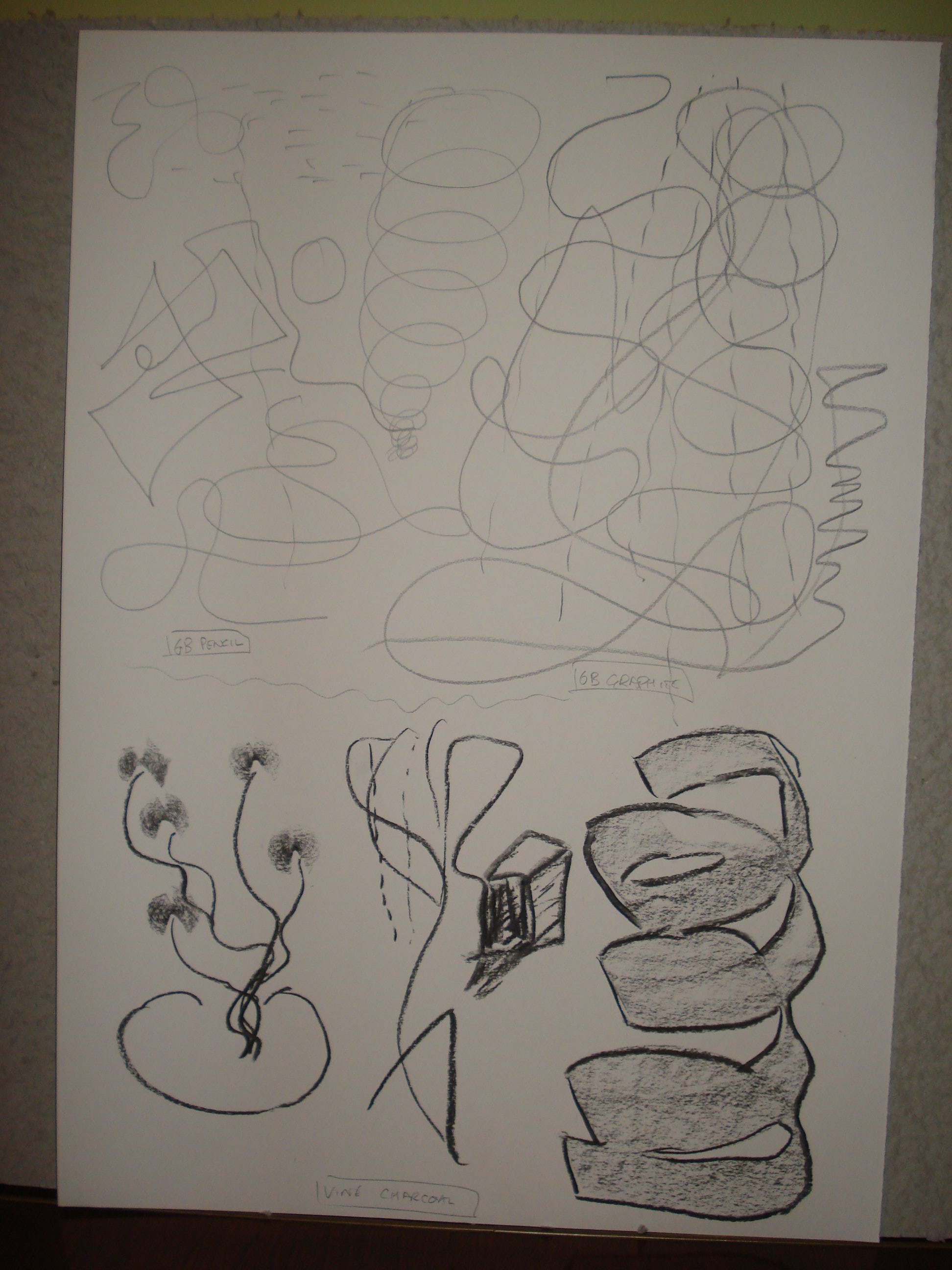
Hmmm. Interesting. I don’t doodle normally and so approached this exercise not knowing how I was going to do it or where I was going to end up. I made a couple of choices. Firstly I was only going to work in black on white paper. Even in media where I had colour options – felt pens, pencils, pastels, I chose to stick to the single colour. Secondly I decided to do most of the work on A2 sheets. This followed on from the first exercise where I found my gestures and mark making was more free when given a larger surface to work with.
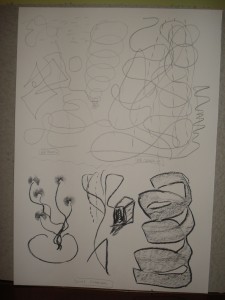
P1E2a

Once I started just letting the marks happen, and just went with whatever they were suggesting, I found it quite a liberating experience and a lot easier than I thought it would be.

When working with just a thin line – pencil, graphite – nothing much seemed to happen. Squiggles, no inclination to follow a particular shape to develop it into something. When I switched to charcoal, using it on it’s edge, the Bow-tie type shapes I had made turned into flowers without really thinking about it. I like the ribbon form – again charcoal on i’s side, but the extra emphasis obtained by going around the edges with a strong line makes this a very interesting form.
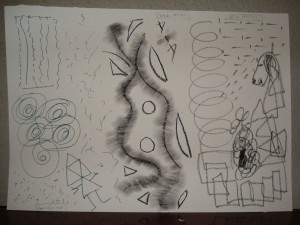
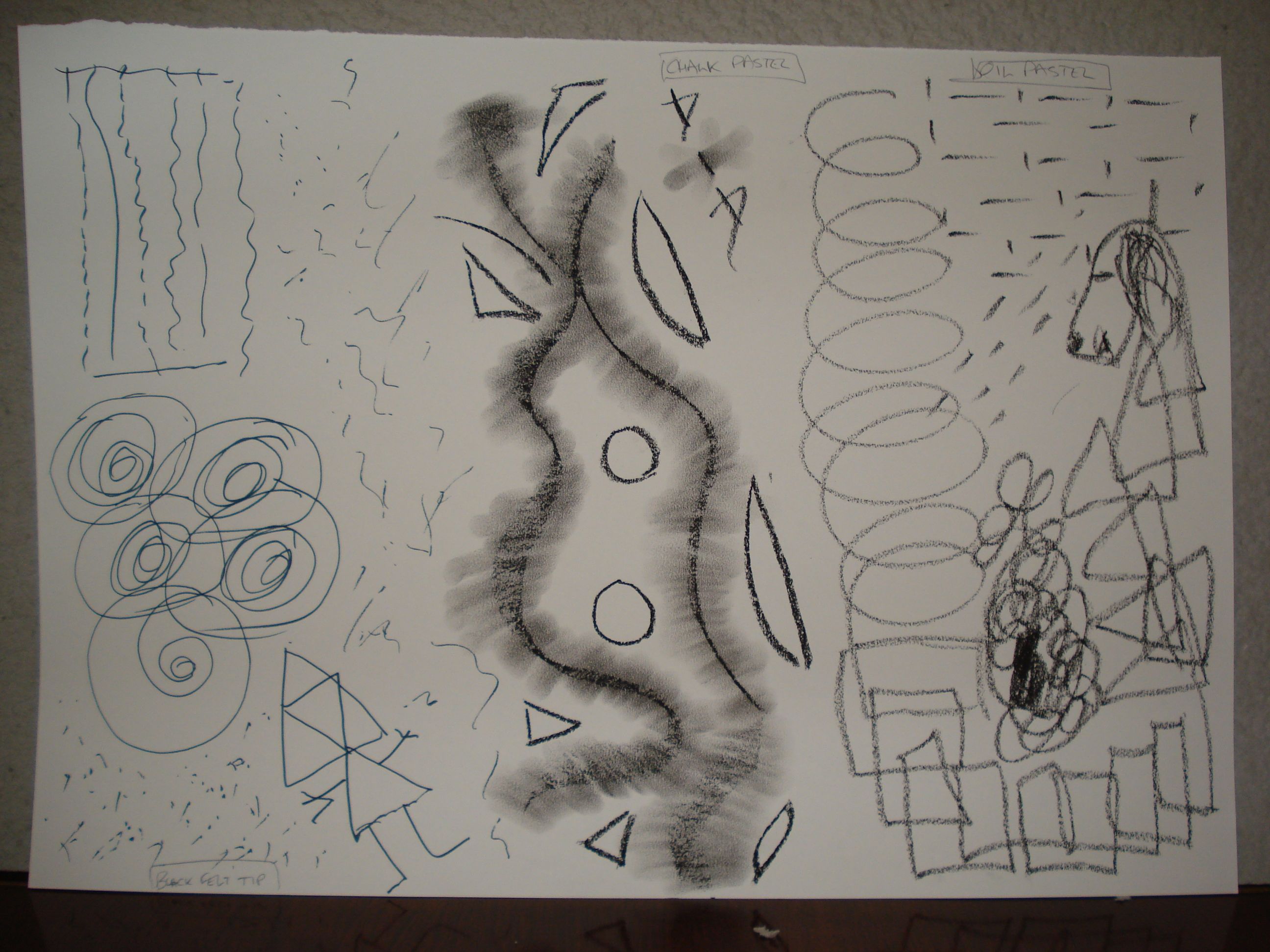
P1E2b

I’d started off with a portrait sheet so then swapped to landscape. The felt pen doodles took on suggestive shapes quite easily – perhaps a set of net curtains or prison bars at the top, perhaps a bunch of roses viewed from above below. Having worked with lines and circles/spirals, I went with triangles and ended up with an ‘origami” girl! The stuff in the middle is chalk pastel which I smudged out with my fingers. Surrounding these linear forms with simple geometric shapes added balance to a “composition”. I really like this. The oil pastels… I’m not sure about. It’s not a medium that feels “right” to me. I’m not sure if it’s the waxiness or the fact that even lines (as opposed to shading) seems to pick up the texture of the table underneath the paper, even though there’s a tablecloth. One shape did morph into a cartoon dog, though!
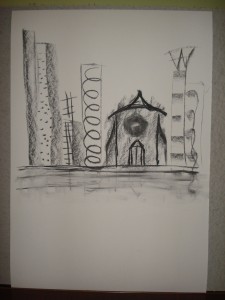
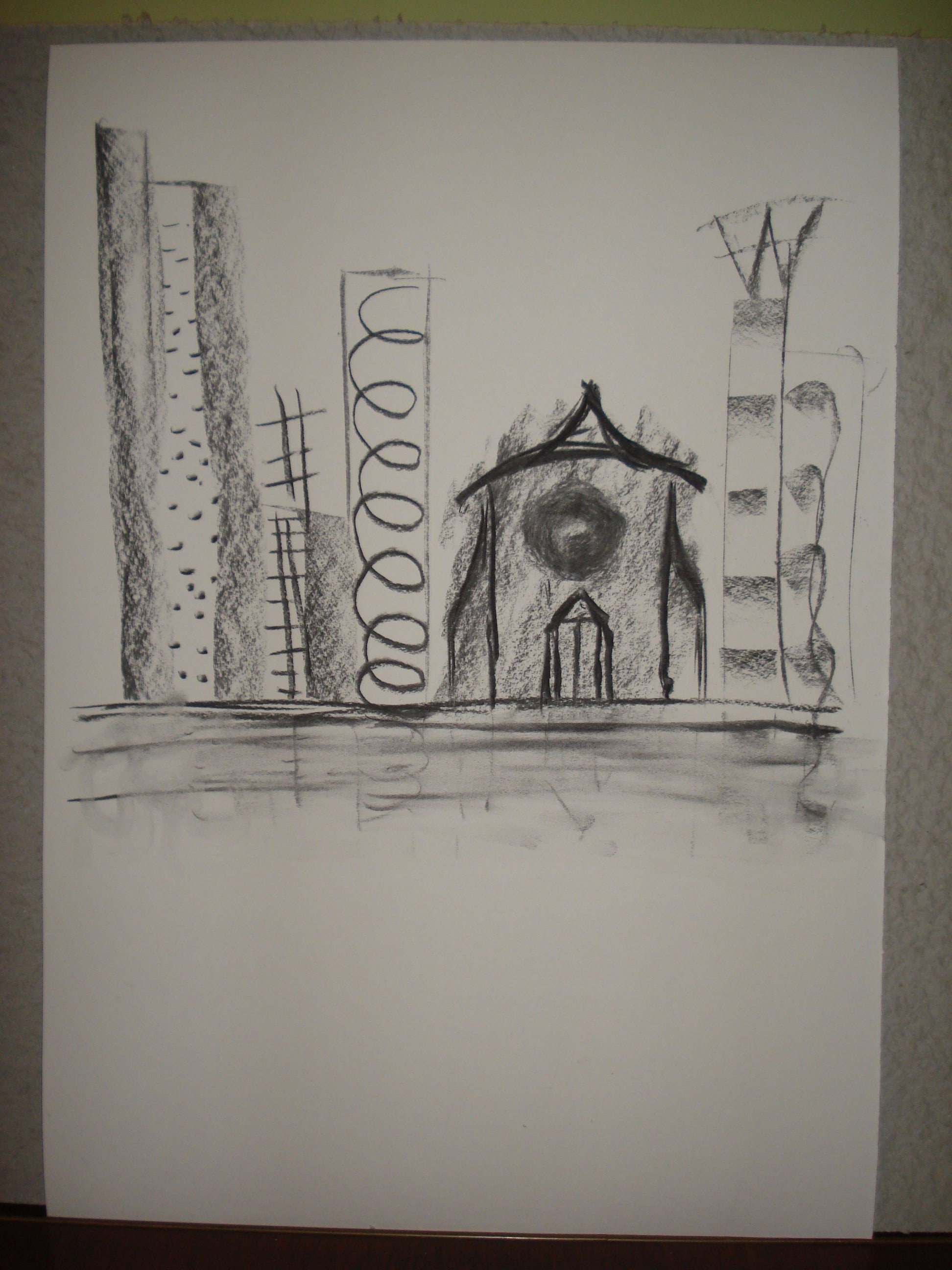
P1E2c

I then started thinking about buildings. Thinking of skyscrapers, I went with portrait paper, long lines with supporting horizontals. Thinking of New York, the grey splodge in the middle was originally a patch of grass in my mind, but then I started putting a lid on it, thinking of St Paul’s in London. The circle came next – originally a random shape, but then reminded me of Rose windows of medieval cathedrals and having recently been reading Gombrich’s History of Art I added a portico and then some fanciful flying buttresses. I didn’t feel drawn to put anything below the nominal ground surface below the buildings, but again going with thoughts of New York I put in a shoreline with some hints of reflections in some water. OK this went a little beyond the brief, but it did start from doodles and I followed it to its conclusion. I’m actually really happy with this!
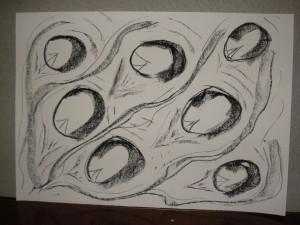
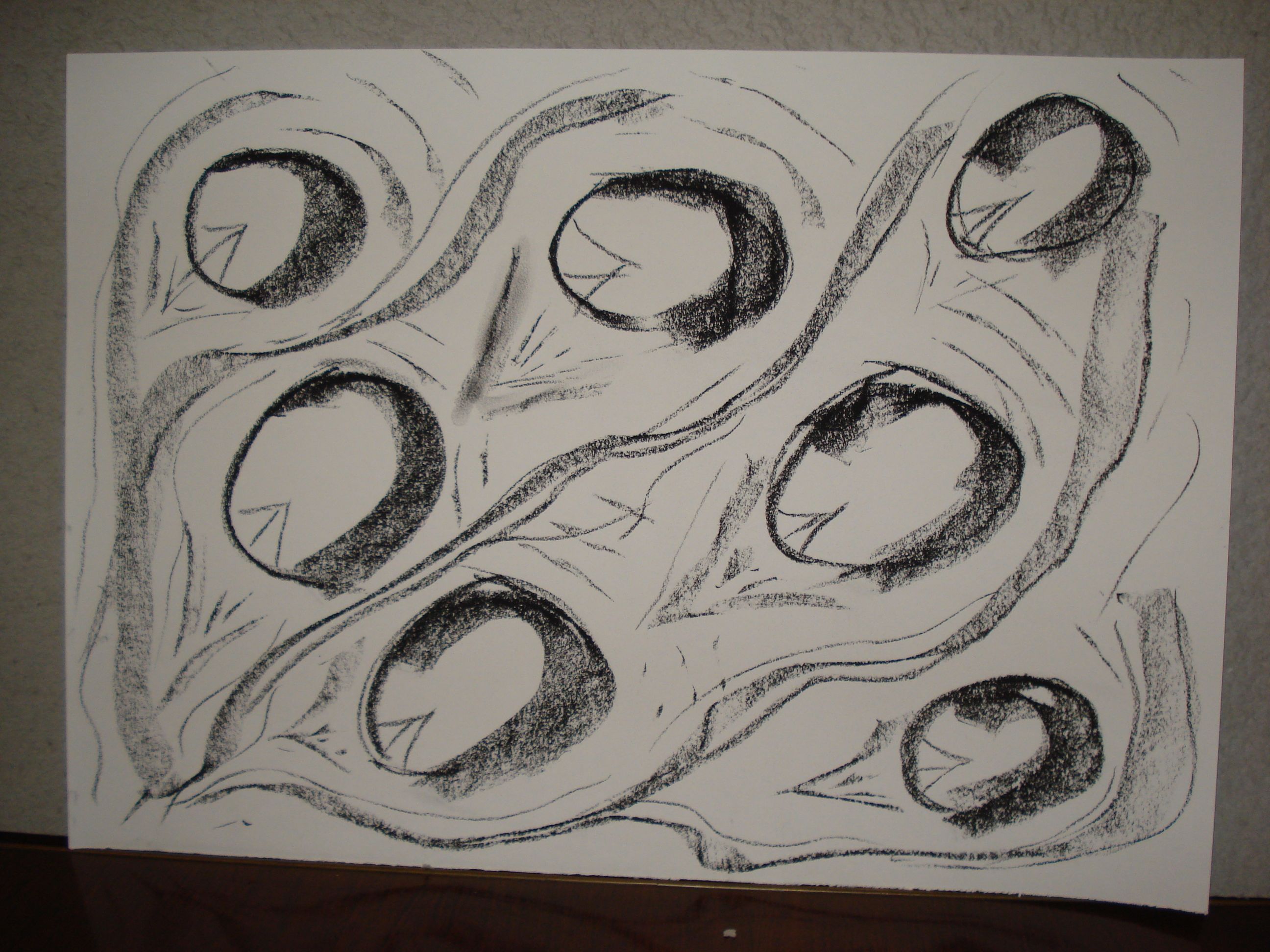
P1E2d

So onto thinking about water and a shift back to landscape format. I tried to go with rounder, curving flowing forms. Starting with the round forms, they became reminiscent of stones in a river and I tried following that train of thought, but I don’t think it was very successful.
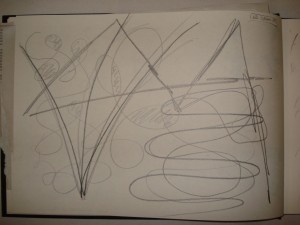
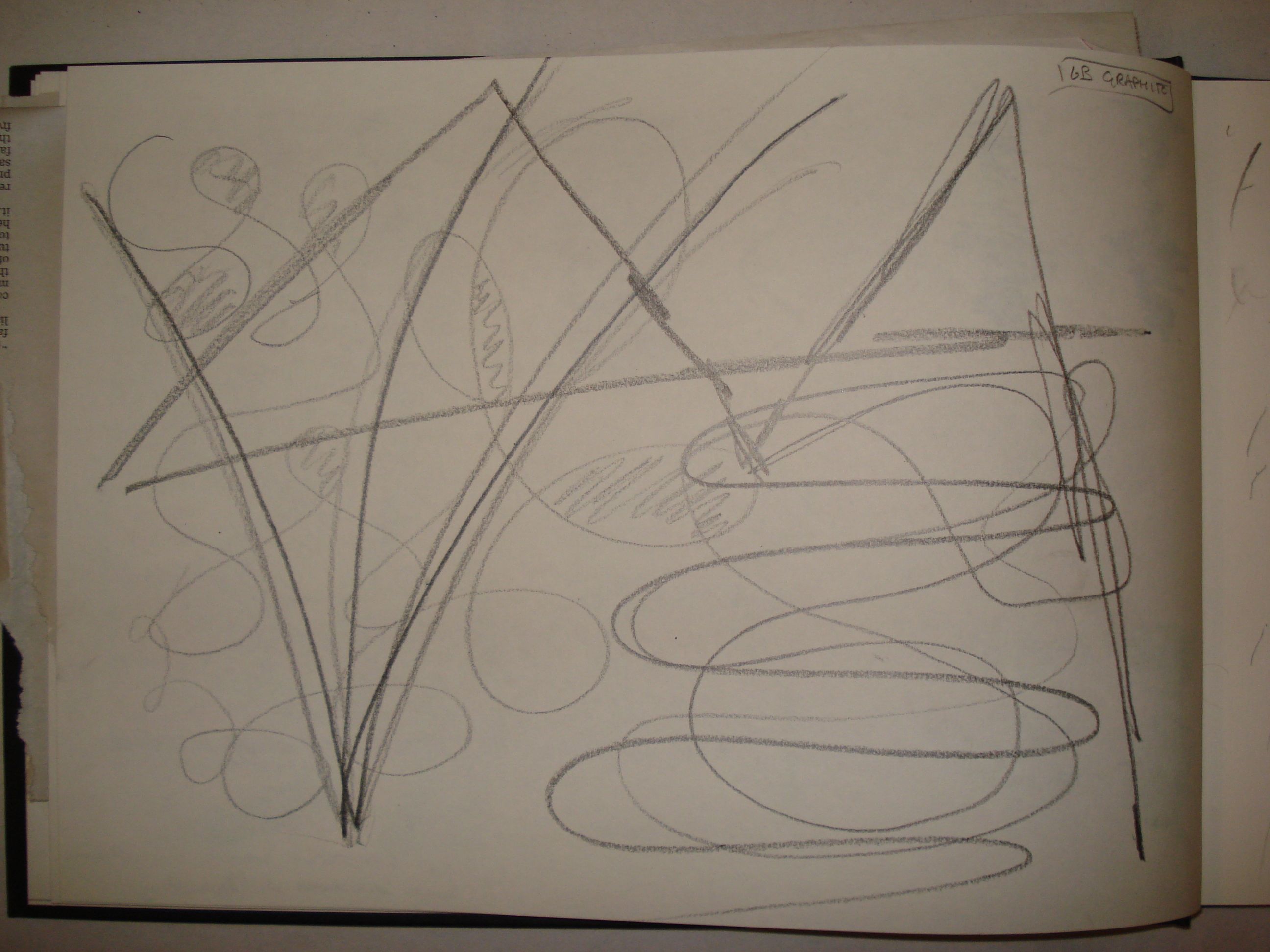
P1E2e

Just to prove a point I did a couple of pages in my sketchbook to deliberately restrict the movements I could make. Of the first page I was still thinking about water and flowing lines, but stronger straight lines took over and you can kindof see a landscape in there.
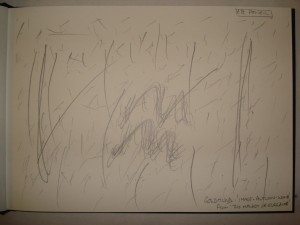
P1E2f

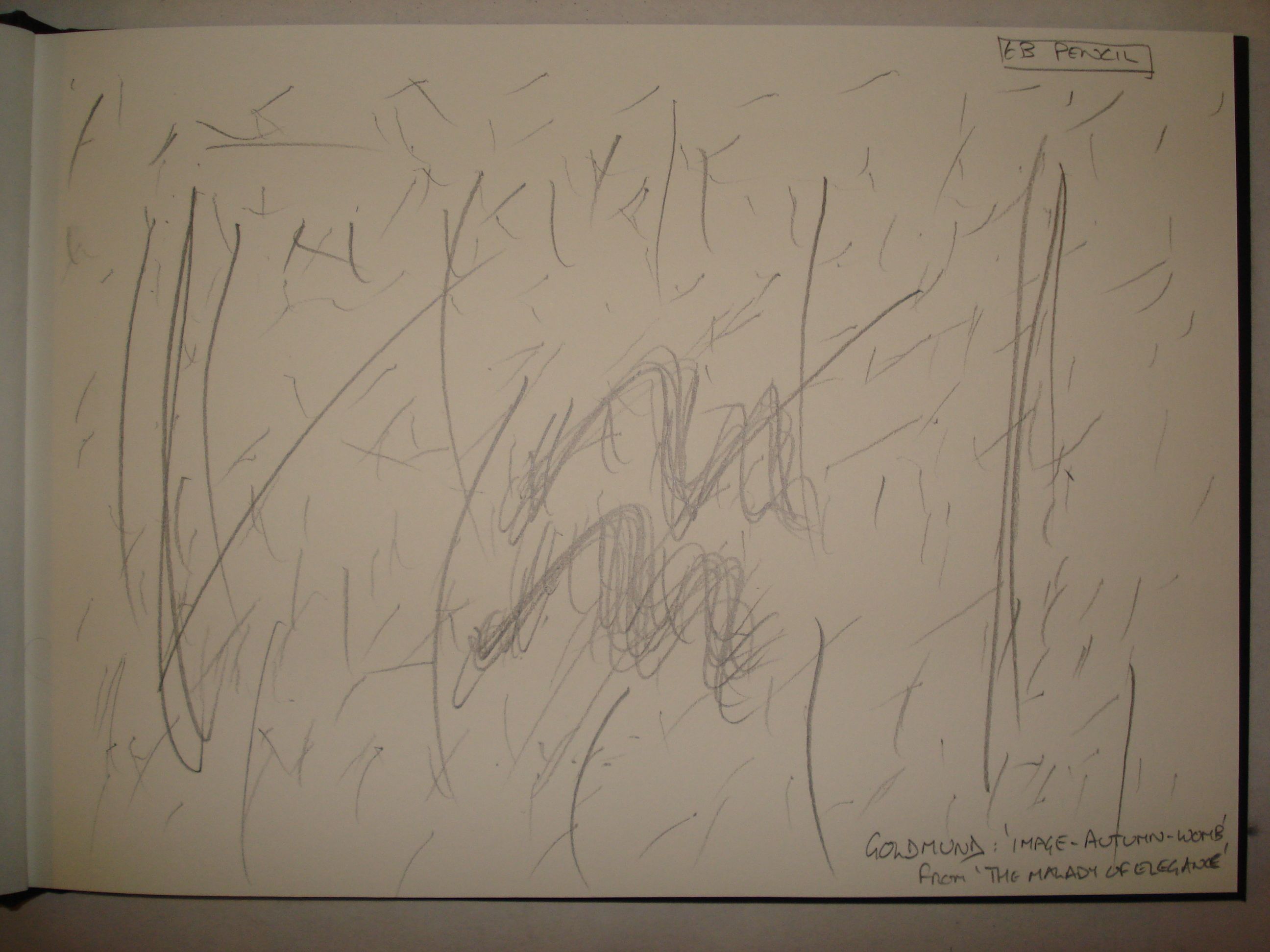
Starting the last page co-incided with the start of a new album on iTunes. I found myself following the staccato notes of the piano with my pencil drawing lost and lots of dashes. I kept going for the whole track, putting stronger lines in where I felt stronger phrases in the piece and wiggles where there were turns of notes. Placement of the marks started out random, but as the piece progressed I became more deliberate in their placement to try and create some sort of balance.

I got a lot more out of this than I thought I would, and have one thing – the skyline – which I really like. I’m not sure if I’d chose to use this method as the basis for starting a “work” but it’s a good exercise.
Project 1, Exercise 1 – Holding Pens and Pencils

P1E1a

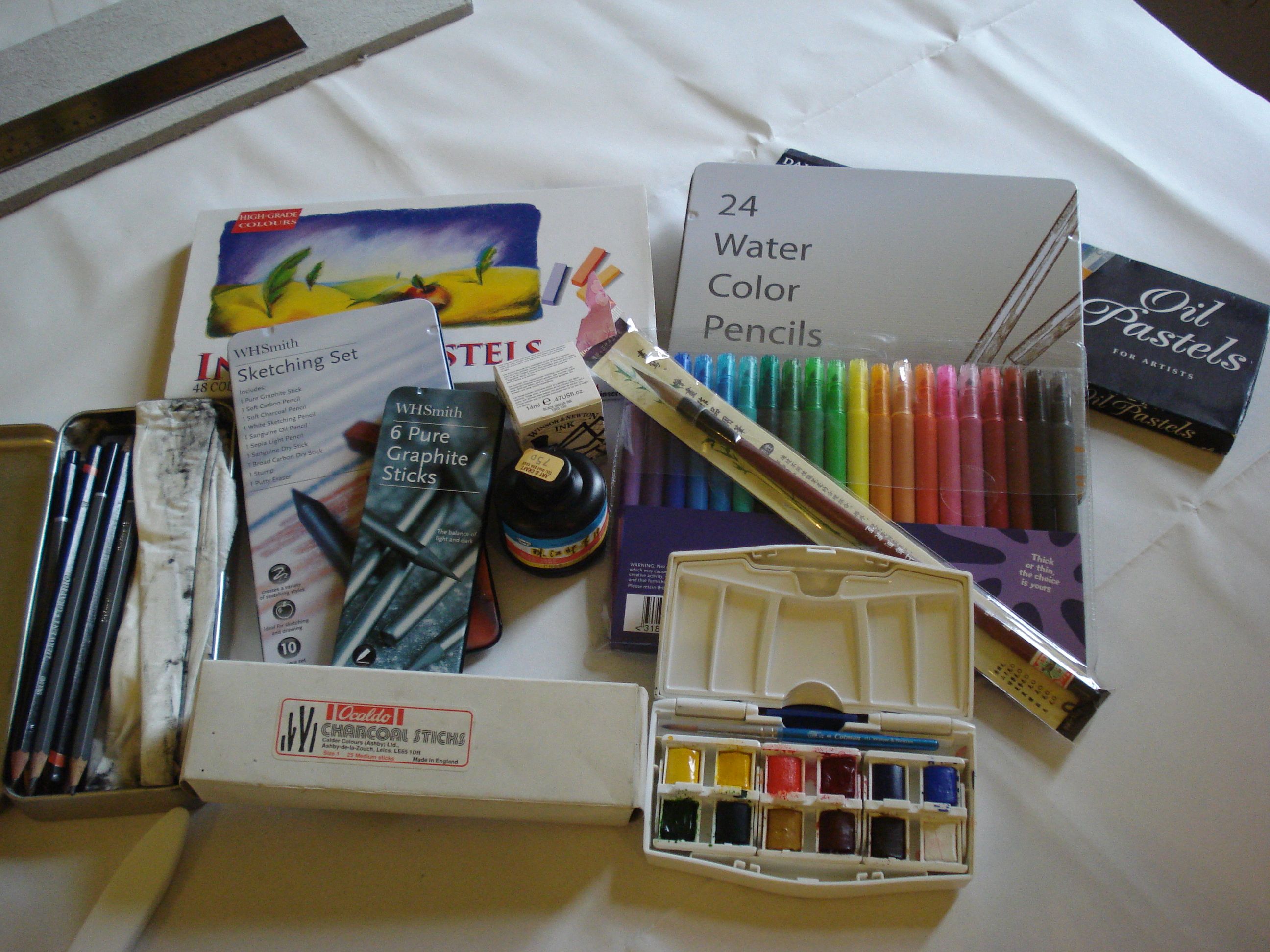
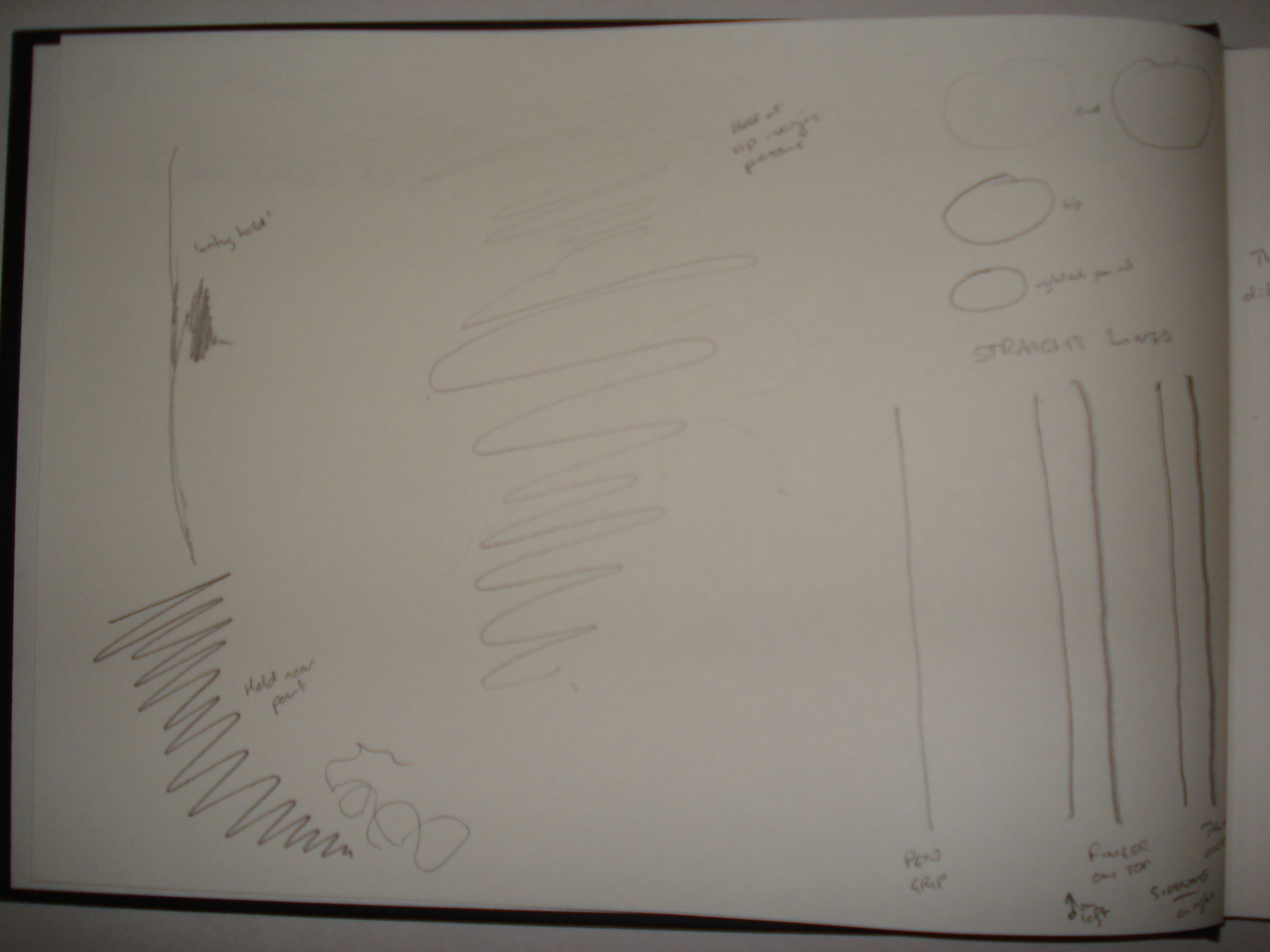
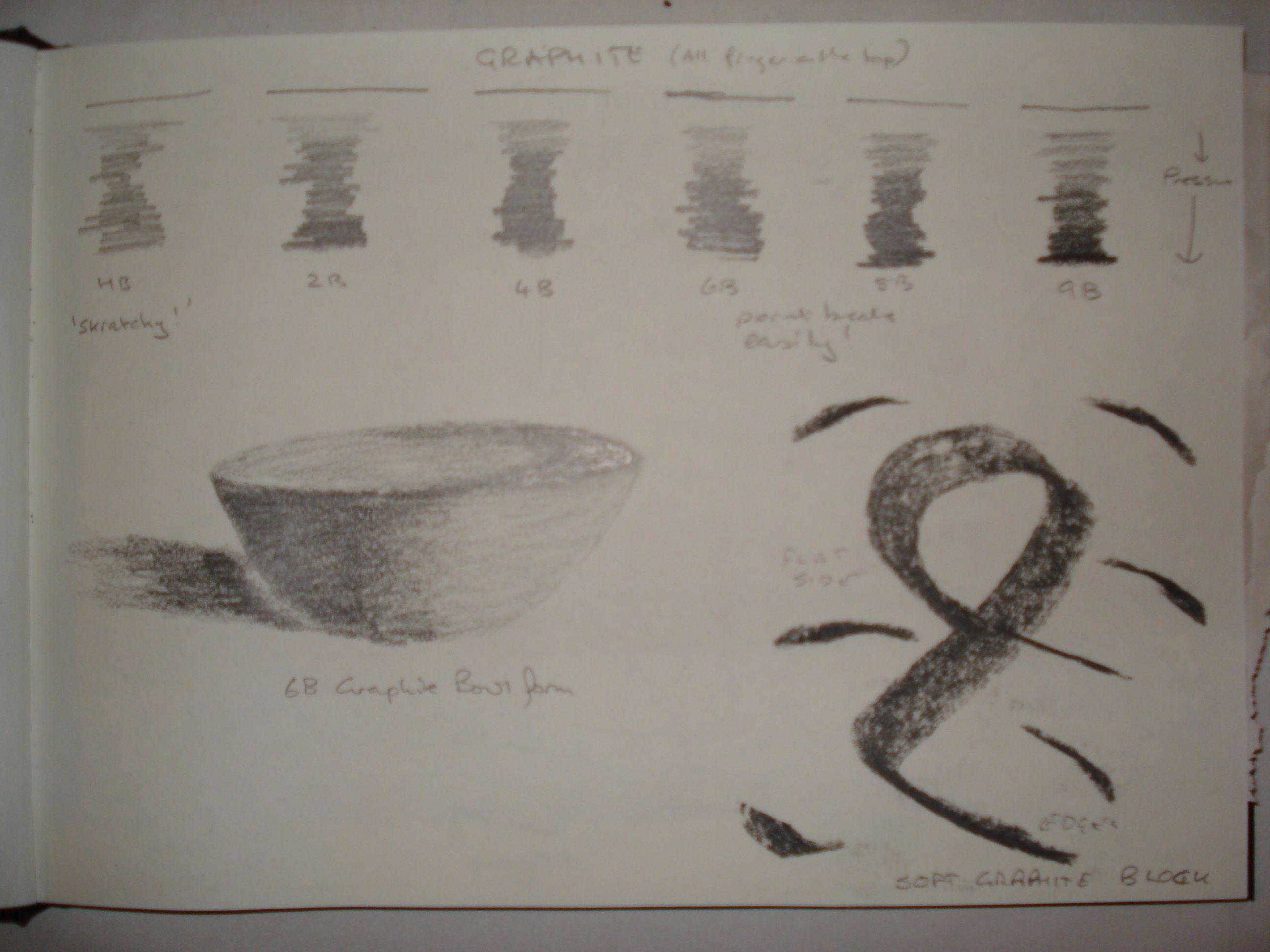
So here’s my collection of mark making stuff – pens, pencils, pastels, graphite, charcoal and so on and so forth. I started off by trying them out in my sketchbook, varying the pressure of the line, and the position where I was holding the “implement”.

P1E1b P1E1c P1E1d P1E1e

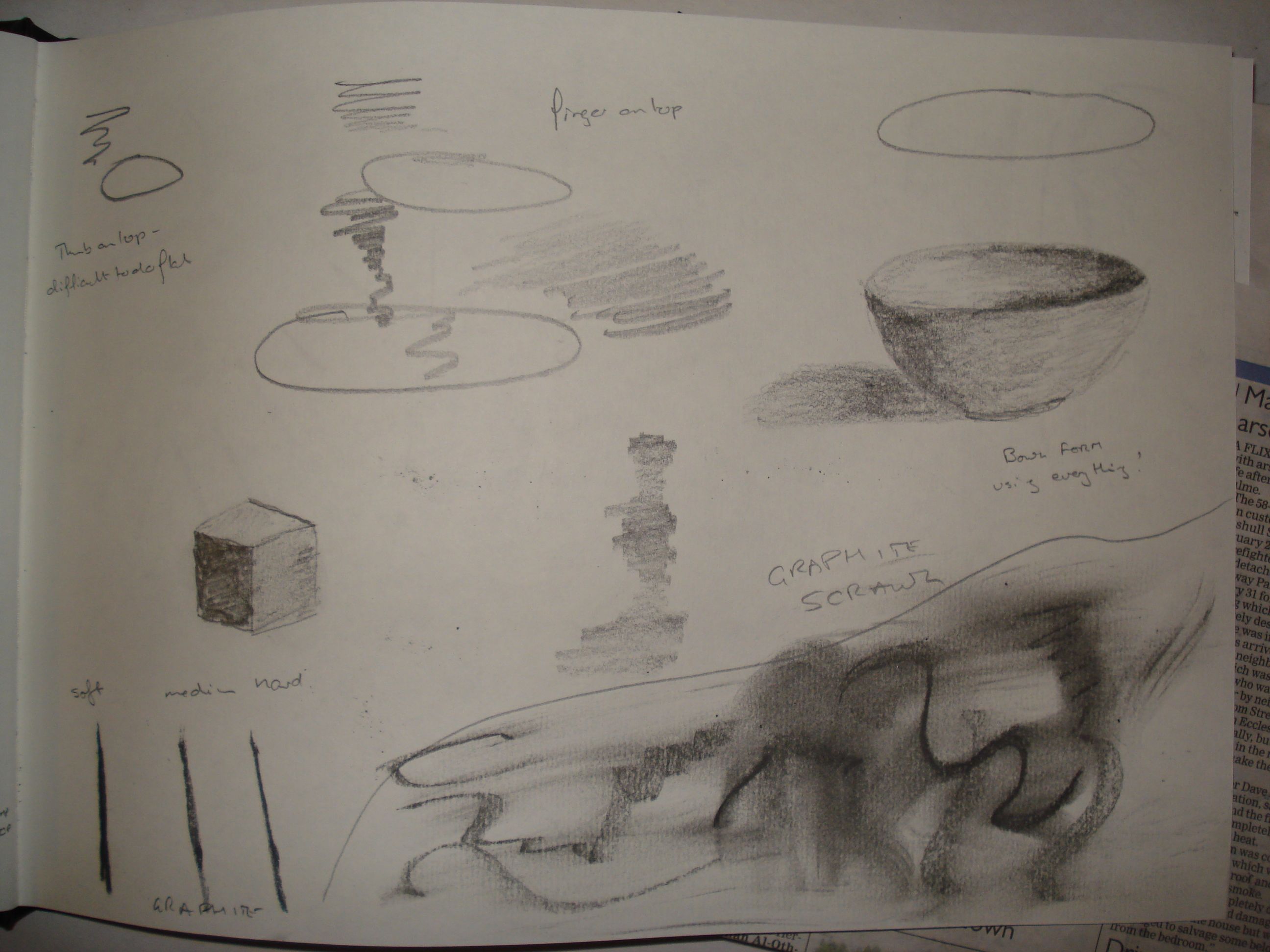
It’s all to do with control and so I drew a couple of “bowl forms” to see if I could control the shading – something I’ve always had a problem with. I’m pretty pleased with the second one – done with a 6B graphite pencil.

P1E1f P1E1g

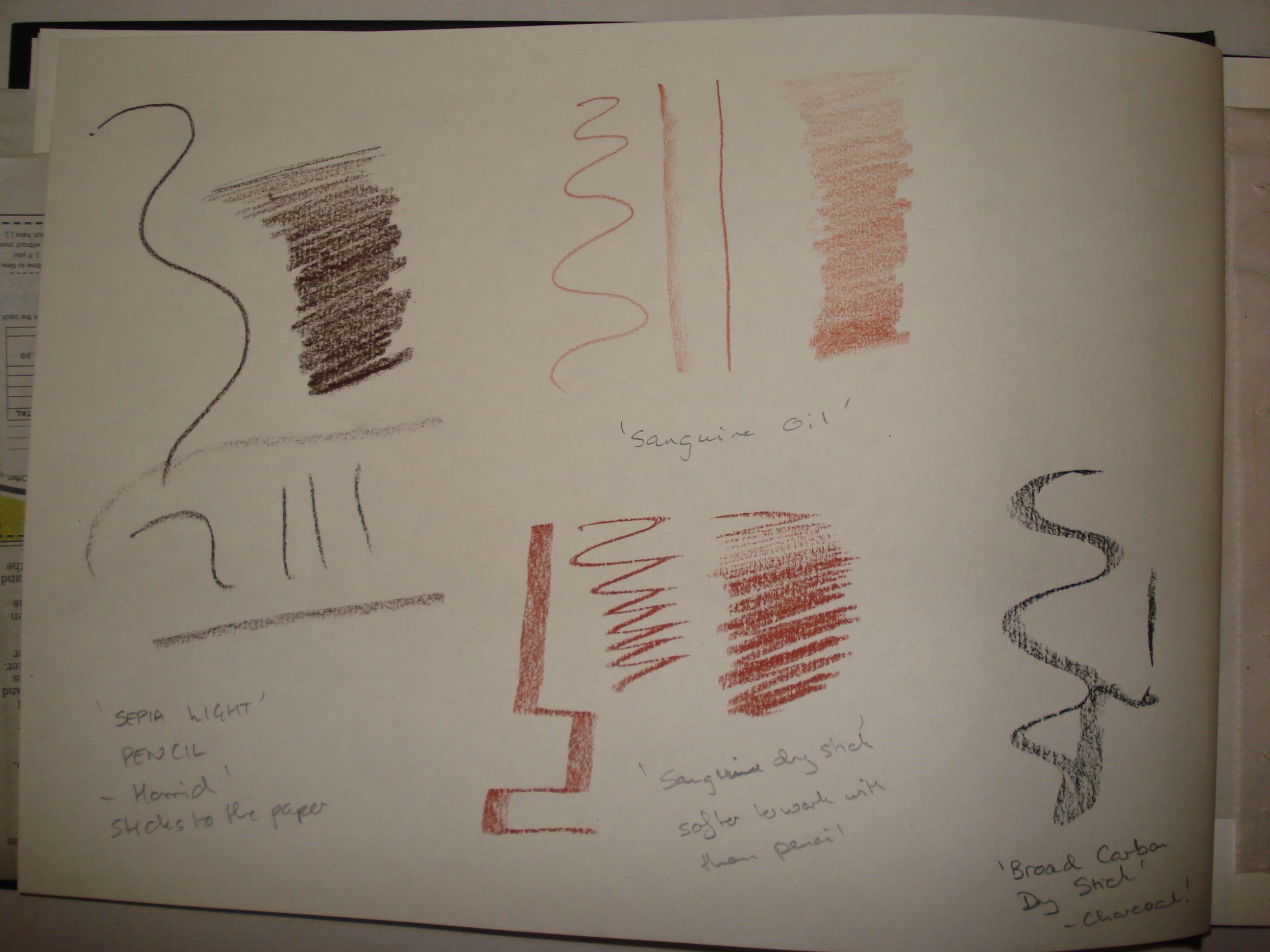
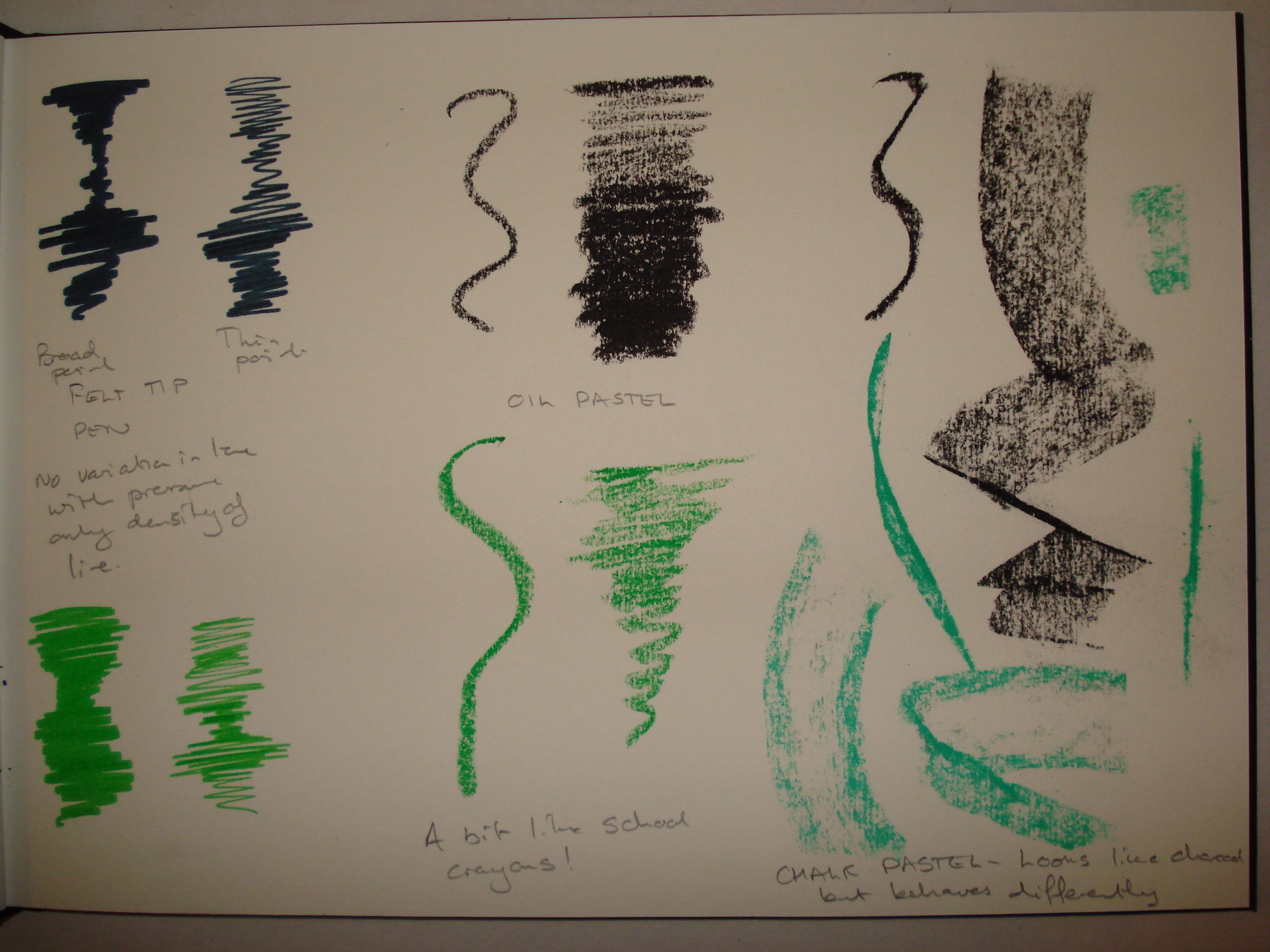
After working with some sepia and sanguine pencils (the sepia pencil was horrible to use – scratchy and sticky) I added a bit of colour in, using a green colour as well as the black for chalk pastels, oil pastels and felt tip pens – just to differentiate them from the other tools as much as anything – the chalk pastel especially looks quite like the charcoal. I was surprised to find that the felt tip pen mark didn’t vary to any significant degree whatever pressure I used.

P1E1h

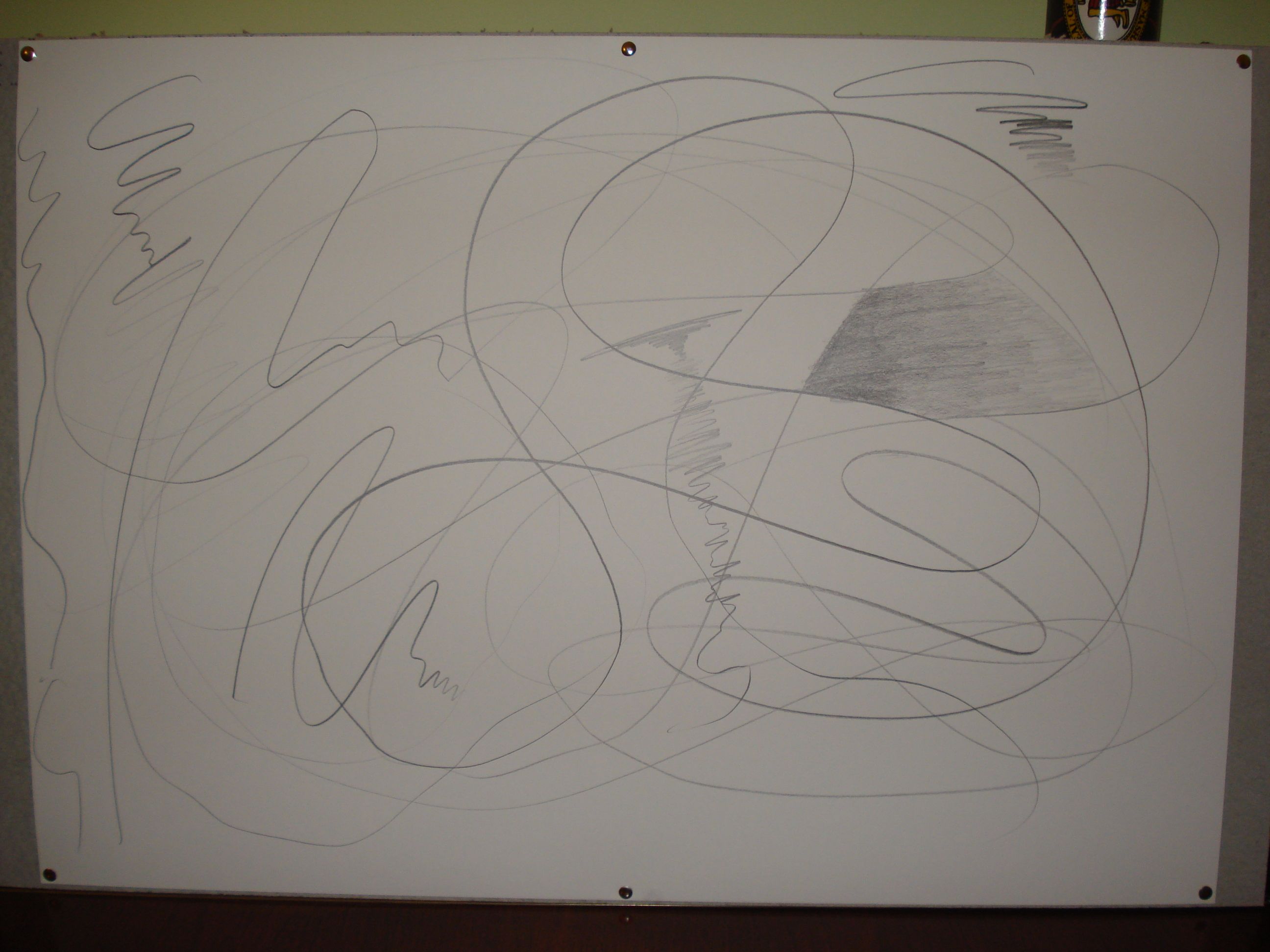
I then moved on to a big A1 sheet of paper and drew big gestures with the 6B graphite pencil which was my favourite of the implements. I again tried a graduated shading one of the random shapes created. It’s not too even; I’ve still got some work to do there!

Time flies like an arrow…

Fruit flies like a banana.

It’s been over six months since I posted here, over six months since I signed up with the OCA.

What happened was that not long after I signed up, I got a new contract – I’m an I.T. Consultant by trade – which has been extremely demanding of my time.  As a result I achieved very little (which is a polite ways of saying I achieved nothing).

So a week or so ago I got a note from the OCA saying, as I hadn’t agreed a submission date for my first Assignment with my tutor, I was going to be put on the “dormant student” list.  This was a kick up the pants.

I’m still working on the contract and it’s still a lot of work, but I’ve made myself a “revision timetable” indicating when I’m intending to do all of the exercises.  This has enabled me to give my tutor an ETA for the first one to be delivered to her.

My girlfriend describes the timetable as “challenging”, and it is.  Most of my spare time will be spent doing these exercises.  I hope I can keep up the pace.

At the moment I’m just concentrating on Assignment 1.  Then I’ll start on Assignment 2 in the same manner.

The journey of a thousand miles… etc etc.

Humbled yet inspired

My “getting the ducks in a row” for the OCA course continues.

The lunchtime reading has moved on to Juliette Aristides’ Lessons in Classical Drawing. The quality of the finished drawings she produces is amazing and yet she holds out the hope that anyone can learn to draw that well.  It makes me think that I can do this!

I’ve also been spending time on the OCA website, looking at other students who are doing the Drawing 1 course, blazing a trail out in front of me.  A lot of them have their learning logs set up set up as blogs and some of these, the ones I feel a resonance with, I’ve listed in the sidebar.  Watching folk develop, looking at the level of skill being shown is very inspiring.  And humbling as they fit the work of the course around their daily lives.

Finally I’ve been contemplating very very basic questions, such as “How are you supposed to hold a pencil?” The DVD that comes with the Aristides book is pretty good for this, as you are watching people produce drawings, rather than just looking at the finished version, or staged, versions.  You can see how they hold the pencil, how tentative their intial marks are, how images are built up.

But also: YouTube! You-flippin’-tube!  I looked up drawing lessons and found loads!  A good backup.

Books

I like books.

Getting the book list for a course and going out and getting them is a really big pleasure for me.  So I downloaded the PDF for Drawing 1 and set about my Amazon account with gusto.  OK it’s not the same as going to a real bookshop, but even the Deansgate, Manchester branch of Waterstones (now without an apostrophe for your ease of spelling pleasure) isn’t what it was – particularly the art section.  I can see it from their point of view though.  It must be a nightmare to have all that cash tied up in stock that people rarely buy.

However, I digress.

Books – Amazon – ordered.  Except for  “The Drawing Book: A Survey of Drawing – The Primary Means of Expression” by Charles Darwent et al. which is apparently out of print.  I spoke to a woman at the publishers – Black Dog – who was very helpful and promised to inform me when it’s reprinted.  If it’s reprinted.

The other book I didn’t order was Gombrich’s “The Story of Art”, partly because it’s only a recommended text and I could get it in the future, but mostly because I’ve already read it.

Last weekend I was in Glasgow for a “do” with my partner’s family.  On Sunday we went up to the Byre’s Road end of town for lunch, and passed an Oxfam Bookshop.  Byre’s Road is student central and so it was likely to be a good Oxfam Bookshop.  In we went, she heading off for the medical section (as she’s a medical herbalist) and I off to the arts section.

And lo there was, sitting on a shelf, an absolutely pristine copy of The Story of Art, 16th edition.  Unpriced.  Thinking it would be the same price as a new copy – in which case I would stick to my original plan – I took it to the desk, to be told it was £6.99!

Right – we’ll have that, then!

I like serendipitous things.  Almost as much as I like books.  Which is where I started.

Chasing the Zen mind

One of the things that’s recommended is to read the course handbook all the way through before you start, so that’s what I’m doing; one section a day during my lunch hour at work.

After reading the first section, I was feeling quite positive but after the second section, with the incredible detail shown in some of the examples I’m all nervous again.

The thing is, I’m really nervous about drawing.  REALLY nervous.  And because I’m nervous, I don’t practice and so I don’t improve.  I really want to BE ALLOWED to proceed the bits of the course I want to do, but because I really want to work towards a degree (gotta get that external verification) I’ve got to do well in the drawing modules, which makes me nervous.

So: what to do?

I know from my work on the Portfolio Course at Bridgehouse Art that I can draw after a fashion and I did improve during that time, and I know that the secret is concentration.  Taking the time to look, taking the time to consider.  Getting into the headspace where there is you, your paper and pencil (or whatever) and whatever it is that you’re drawing.

A Zen place.

And that means allowing yourself the time to dedicate to the drawing.  No alarms, no phones, no distractions.  You can’t really do your homework on the bus on this course.  Unless, of course, you’re drawing the people on the bus…

In other news, the booklist is all on a wishlist on Amazon, just waiting to be ordered (apart from the one that’s out of print, of course!) and I’m planning on buying some really nice cartridge paper, but I’m waiting until the end of the course read through to see if I need anything special at any point (Bockingford is mentioned at one point in Section 2.

Open College of the Arts

I’ve recently signed up with the Open College of the Arts.

I’ve been considering it for a while, but my hand was forced by impending huge fee increases which would have made me even more reluctant to take the plunge.

The details of the whys and wherefores can be found on the OCA Profile page, but the bottom line is that whereas I’ve had practice at some of the techniques of art, but I need more practice at thinking like an artist, developing ideas etc.

John Cage apparently once said “I have nothing to say, and I am saying it” and that in turn was an inspiration for Gerhard Richter while he was making the Cage Paintings.  Personally, I’d rather find something to say…

I wanted, really, to start with painting, but was advised by the Student Office that they like people to start with Drawing 1, as it’s the basis for painting.  Whilst I appreciate this point of view I feel a bit like I did as a kid being told to go off and practice my scales and arpeggios when what I wanted to do was write my own songs.

So I’m doing Drawing 1, and I know it’ll help me with other aspects of at in the future, but I’m not sure I’m going to enjoy it.  Please see the definition of the Scots word thrawn.

Gah,  that’s just being too negative before I even start; I just have to find a way into it, is all.